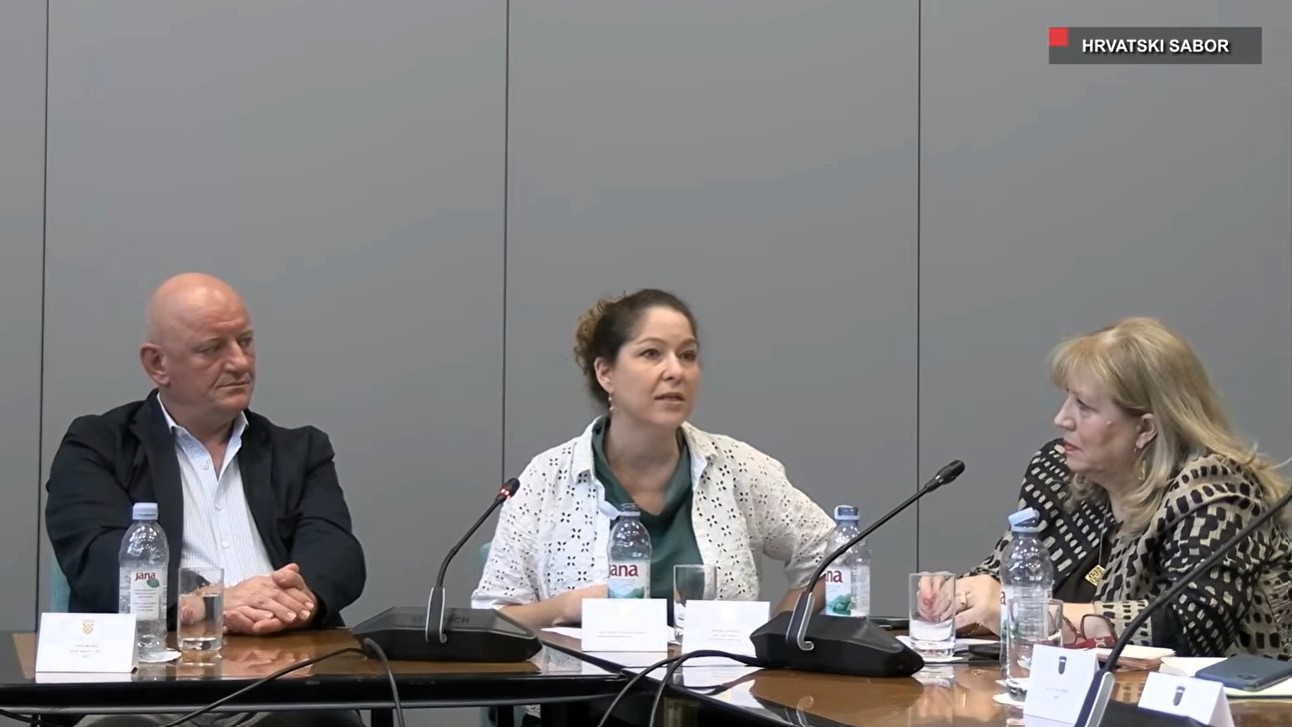
Ombudswoman Tena Šimonović Einwalter took part on 27 May 2026 in a round table on palliative care in Croatia, organised by the Bridge (Most) party and held in the Croatian Parliament.
Speaking about the palliative care system, Ombudswoman Šimonović Einwalter emphasised that this is, above all, a matter of the rights of patients, their family members, but also healthcare professionals — and, more broadly, a human rights issue, the respect for which is the responsibility of the state.
The Ombudswoman also highlighted her long-standing recommendation to the Government of the Republic of Croatia on the need to adopt a National Programme for the Development of Palliative Care, as the basis for improving the current situation, defining the fundamental strategic direction and standardising protocols.
Although this document has not yet been adopted, according to announcements from the competent Ministry of Health, its draft should soon be submitted to public consultation. The Ombudswoman stressed that this should be done as soon as possible, as Ministry data indicate that between 26,000 and 46,000 people need palliative care each year, while fewer than half of those in need actually receive it.
At the same time, providing the necessary care to patients also has various consequences for those close to them, who try to ensure they receive care, support and the least possible suffering until the very end.
The Ombudswoman also pointed to key problems in the palliative care system, which include, among other things, a chronic shortage of inpatient capacities, a significant lack of professional staff and incomplete mobile teams, undefined quality standards, a lack of structured planning and continuous support for patients, difficulties in exercising the right to home healthcare, insufficient cooperation between the healthcare and social welfare systems, insufficient training of professional staff, inadequate communication with users and their families, and unequal availability of palliative care across Croatia.
In this context, the Ombudswoman also referred to recommendations aimed at addressing these problems, both individual and systemic. For example, it is necessary to standardise the discharge procedure for palliative patients, as well as the organisation of non-emergency medical transport, with the aim of preserving the human dignity of the most seriously ill patients.
It is also important to improve the availability of information and communication with palliative patients and their family members, as well as to ensure equal access to palliative care throughout Croatia. It is also necessary to ensure better exercise of the right to home healthcare, including the possibility of taking sick leave to care for elderly and infirm parents, as well as to provide psychological support to patients themselves and to their family members.
Cooperation between the healthcare and social welfare systems should be improved, including by strengthening support for professional staff and enabling additional training and incentive measures for performing this exceptionally demanding work.
The Ombudswoman also pointed to the need to change pain management protocols, including issues related to therapy and the role of nurses, as well as the need to recognise and strengthen the role of civil society organisations in palliative care, as they have to a large extent taken over the role and responsibilities of the state in this area.
In addition to Ombudswoman Šimonović Einwalter, the discussion was attended by Member of Parliament Božo Petrov; Ivana Portolan Pajić from the Ministry of Health; Maja Vajagić from the Croatian Institute of Public Health; Ružica Marinić from the Jedra Association; Katija Ćulav from the Croatian Society for Palliative Medicine; Marijana Braš from the School of Medicine, University of Zagreb; Ivica Belina from the Coalition of Associations in Healthcare; Iva Kirac from the Institute for Gastroenterological Tumours of Croatia; Sara Bajlo Pleština from the Croatian Alliance for Rare Diseases; Irena Bibić from the Dravet Syndrome Croatia Association; Velimir Korak from the Croatian Society of Prostate Cancer Patients; Dražen Vincek from the Croatian Association for Leukaemia and Lymphoma; Jelena Pravica from the MijelomCRO Association; Mirela Stanić-Popović from the Krijesnica Association; Ivana Kalogjera and Goranka Perc from the Nismo same Association; Vlasta Zmazek from the Debra Association; Jasminka Stepan Giljević from the Croatian Association of Friends of Hospice; representatives of mobile palliative care teams and healthcare professionals working in palliative care. The discussion was moderated by Ivan Bekavac.
During the discussion, the focus was placed on the current state of palliative care in Croatia, patients’ needs, existing challenges in the system and possible solutions for its improvement, with the aim of strengthening and developing an accessible and sustainable palliative care system as an integral part of medicine and healthcare, and an important element in realising citizens’ right to health.
More information on this topic is also available in the Ombudswoman’s Report.