Between September and December 2025, the Ombudswoman’s Office organized a series of lectures for students of teacher training faculties on combating discrimination and promoting equality in education.
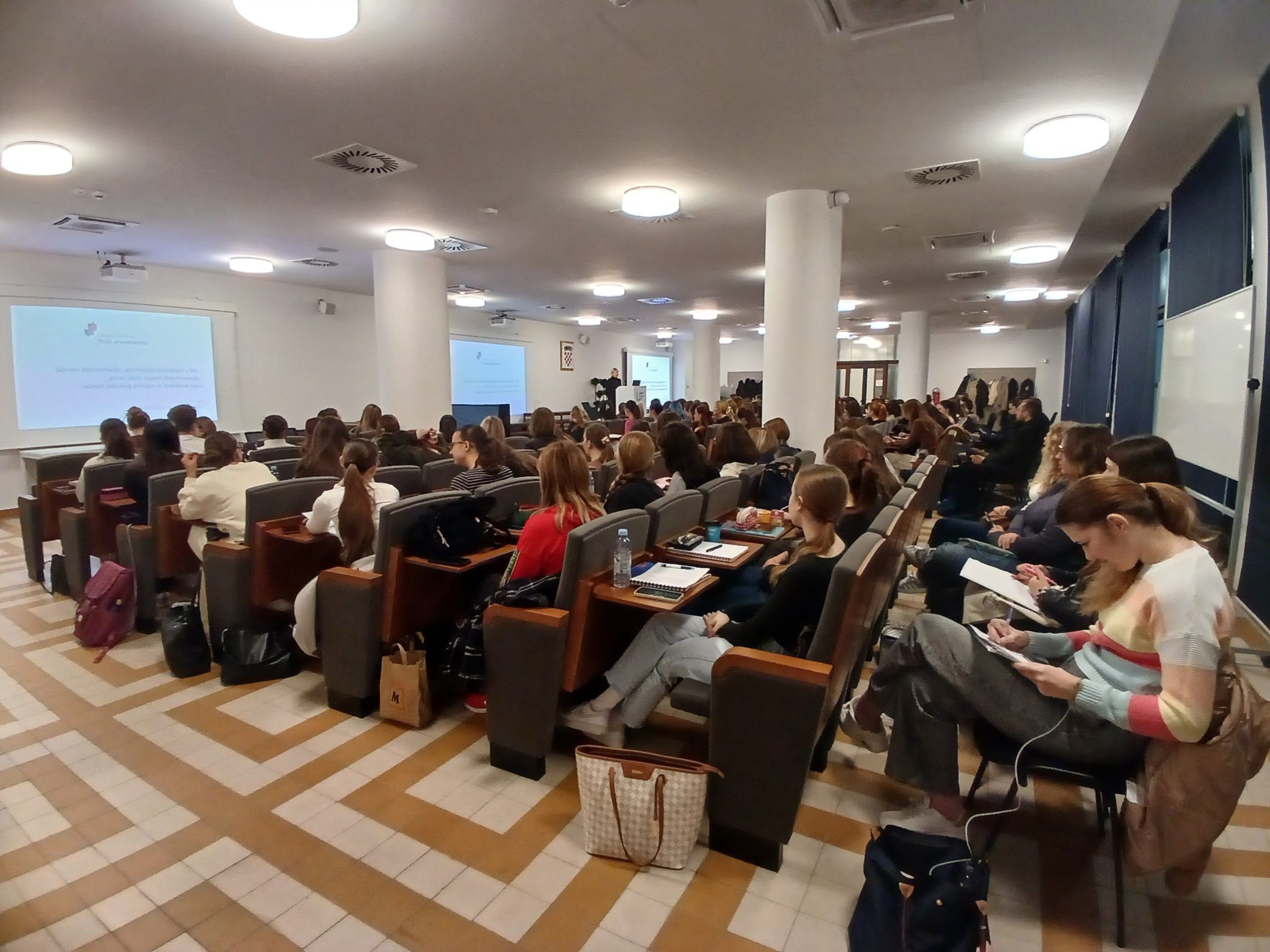
The lectures were delivered to over 280 students in Zagreb, Čakovec, Rijeka, Osijek, and Slavonski Brod. These students, as future teachers, will play an important role in creating inclusive school environments and raising awareness about prejudices and stereotypes. The lectures provided them with an additional opportunity to learn about combating discrimination and racism and promoting equality—topics that are not yet systematically represented in teacher education programs.
The lectures were led by Nikolina Patalen, Advisor to the Ombudswoman, and Lana Jurman from the Centre for Peace Studies. Students were introduced to the legal and institutional framework for protection against discrimination in the Republic of Croatia, including the Anti-Discrimination Act, and the role of the Ombudswoman as the central body for combating discrimination.
The Ombudswoman also presented the findings of a 2022 survey on public attitudes and awareness of discrimination and its various forms. The survey offers insight into citizens’ perceptions of the prevalence of discrimination, the persistence of prejudices and stereotypes, awareness of legal and institutional mechanisms for protection, and personal experiences of discrimination. It was emphasized that discrimination is significantly more widespread than official complaints suggest, with ignorance, fear, and distrust in institutions among the main reasons for underreporting.
Special emphasis was placed on different forms of discrimination, presented to students through concrete examples from everyday life and the educational context. The lectures specifically focused on the situation of the Roma national minority in education. According to the Ombudswoman’s research, 18.3 % of respondents consider Roma to be the most frequent victims of discrimination, identifying them as the most marginalized group in Croatia. Furthermore, 92.4 % of Roma live below the poverty risk threshold. Many Roma families live in segregated settlements in overcrowded housing, often without basic communal infrastructure.
All of these factors have a significant impact on the education of Roma children. A particular challenge is school segregation. Given the low participation of Roma children in preschool, as well as later in secondary and tertiary education, primary schools are often the only setting in which Roma children can socialize with peers from the majority population. When educated in segregated environments, children lack opportunities to interact with majority peers while acquiring knowledge, developing attitudes, confidence, and social capital. The same applies to children from the majority population, particularly in areas with larger Roma communities, where the absence of interaction with Roma peers contributes to the formation of stereotypes and prejudices and hinders the development of social ties.
The lectures were designed to encourage students to reflect on concrete instances of discrimination in education, and on the role of teachers, school staff, local authorities, and the media in preventing discrimination and promoting equality in schools. The examples and content were based on real situations in school settings and emphasized opportunities for action within the existing system.
Evaluations conducted after the lectures indicated a high level of interest and motivation among students to continue learning about human rights, combating racism and discrimination, and fostering an inclusive educational system. The lectures were delivered within the framework of the project “F.R.E.D. – Fostering Racial Equality and Diversity.”