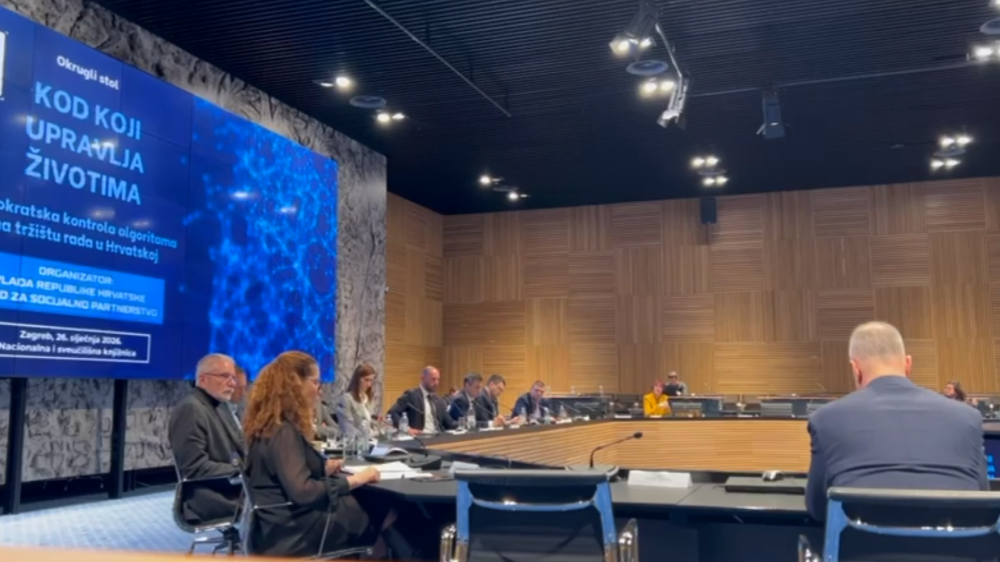
Ombudswoman Tena Šimonović Einwalter participated in a roundtable on 26 January 2026 titled “The Code that Governs Lives – Democratic Control of Algorithms in the Croatian Labour Market,” dedicated to the impact of artificial intelligence (AI) and digital algorithms on work and employment, workers’ rights, and the world of work. The event was organized by the Office for Social Partnership of the Government of the Republic of Croatia and held at the National and University Library in Zagreb.
In addition to the Ombudswoman, participants in the discussion included Minister of Justice, Public Administration and Digital Transformation Damir Habijan, Head of the Office for Social Partnership Krešimir Sever, Bojan Batinić from the Ministry of Economy, Darije Hanzalek from the Trade Union of Printing and Media Industry, Siniša Đuranović from the Croatian Employers’ Association, Iva Bjelinski from the Faculty of Law at the University of Zagreb, Zoran Aralica from the Economic Institute, and other stakeholders.
Participants discussed, among other topics, ways to balance innovation with the protection of workers’ rights, concrete measures and standards to be included in national guidelines, strengthening the capacities of social partners to effectively monitor AI system implementation, and the need for all stakeholders to participate in shaping future regulation.
In addition to discussing amendments to the Labour Act in the context of the Directive on platform workers, Ombudswoman Šimonović Einwalter highlighted the need to also consider amendments to the Labour Act regarding the use of AI systems. She further stressed the necessity of enacting a Law on the Implementation of the EU Artificial Intelligence Act, which would elaborate on all provisions of the regulation and enable its effective enforcement, ensuring that all relevant legislation is harmonized in accordance with the regulation’s purpose, content, and technical provisions.
The Ombudswoman also recommended the ratification of the first globally legally binding Council of Europe Convention on the Impact of Artificial Intelligence on Democracy, the Rule of Law, and Human Rights, which was jointly adopted by EU member states that are also members of the Council of Europe, other Council of Europe member states, and the United States of America.
She emphasized the importance of maintaining a publicly accessible registry of all entities using AI tools and systems, which would assist both workers and the public in knowing when AI is being applied—a matter that is crucial for legal protection, including the right to appeal.
In concluding her remarks, Ombudswoman Šimonović Einwalter stressed that for the effective and responsible use of AI systems in the workplace, as well as in all other areas of contemporary life, education is key—for workers themselves, employers, and citizens regarding the protection of their rights and the prevention of discrimination in AI system use. At the national level, where the state acts as both regulator and employer, it is essential to ensure adequate capacities for the responsible and effective use of AI systems while encouraging citizens to learn about responsible technology use and, in doing so, safeguard all their rights.
The discussion aimed to promote a comprehensive national dialogue on algorithmic governance in the labour market, with the goal of fulfilling Croatia’s obligations to establish an institutional and legislative framework that protects workers while respecting fundamental rights and freedoms. This is particularly necessary following the entry into force of the EU Artificial Intelligence Act and after the European Parliament adopted, in December 2025, the legislative initiative for the Directive on the Protection of Workers from the Risks of Algorithmic Management.