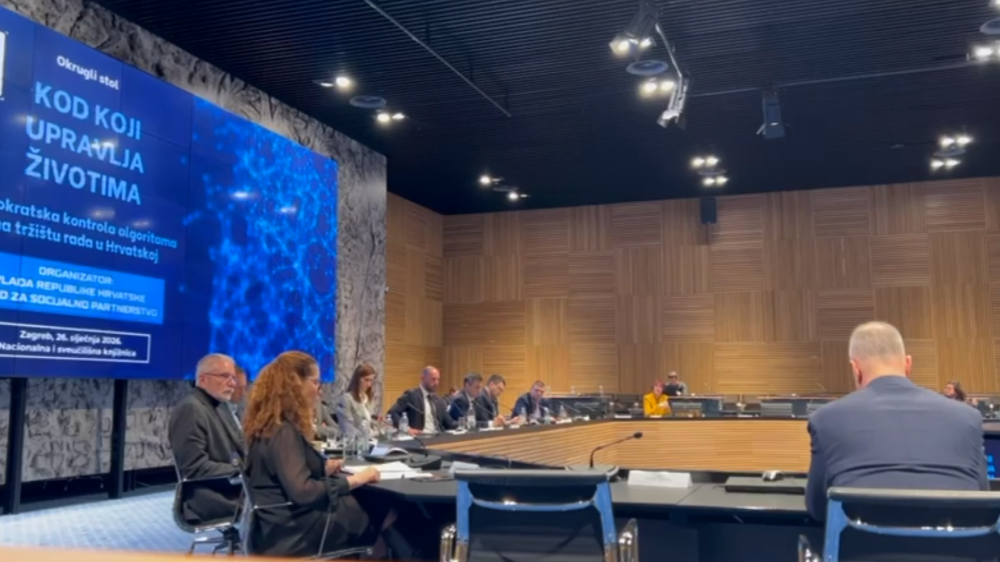
The significance of the EU Charter of Fundamental Rights in national judicial practice and its use in strategic litigation in the field of human rights protection and anti-discrimination was the focus of a conference held on 16 February 2026, attended by Ombudswoman Tena Šimonović Einwalter and Deputy Ombudswomen Dijana Kesonja and Tatjana Vlašić.
The conference was aimed at exchanging practical experience in litigation and the strategic use of EU law and the EU Charter of Fundamental Rights, offering a forum for discussion among experts in human rights protection and anti-discrimination, with the goal of enhancing capacities for the effective application of the Charter.
Opening the conference, Ombudswoman Šimonović Einwalter emphasized that, due to the broad mandates of national human rights institutions and equality bodies—which encompass two of the five mandates of the Ombudswoman institution—these institutions are key to the effective implementation of the Charter.
This was also recognized by the European Commission in its 2020 Strategy to strengthen the application of the Charter of Fundamental Rights in the EU, which highlighted that such institutions monitor, implement, and promote the Charter on the ground, provide information and support to victims of fundamental rights violations, and cooperate with other national institutions to improve awareness and use of the Charter itself.
The Ombudswoman also addressed the significance of the Charter, highlighting three aspects in the national context. The first concerns the work of national courts, which play a crucial role in the real enforcement of the Charter when operating within EU law. Although courts have begun to refer to the Charter, knowledge of it is still limited to some extent, and judges need additional training.
The second aspect relates to the work of state and public administration. Unfortunately, insufficient knowledge of the Charter remains a problem, especially at regional and local levels. The Ombudswoman emphasized the important role of national human rights institutions and equality bodies in the legislative process and their regular participation in public consultations and parliamentary committee work. Nevertheless, the opinions and recommendations they issue are often insufficiently taken into account, and it is especially concerning that feedback from the authorities to whom they are addressed is frequently entirely absent.
The Ombudswoman added that, when using EU funds, competent authorities must adhere to the Charter. Experience from the institution of the Ombudswoman also indicates a need for further capacity-building and strengthening of all stakeholders involved in this process.
The third aspect concerns the generally important role of civil society organizations in democracy and the rule of law. The Ombudswoman also referred to the Recommendation on promoting the engagement and effective participation of citizens and civil society organizations in policymaking from the 2024 European Commission Annual report on the application of the Charter, which encourages Member States to provide sufficient funding for this purpose and to strengthen the resilience of organizations to the threats and attacks they face.
The Ombudswoman noted that strengthening civil society organizations is one of the four pillars of the Strategy to strengthen the application of the Charter. She further added that at the end of 2025, the EU adopted the EU Strategy for Civil Society Development, emphasizing the significance of civil society in promoting and protecting the values contained in Article 2 of the Treaty on European Union (TEU) and in the EU Charter of Fundamental Rights. In the national context, the Ombudswoman recalled her long-standing recommendation on the need to adopt such a policy at the national level, which has not yet been implemented.
The conference also included two panels. In the discussion on systemic and structural violations of fundamental rights, with an emphasis on the responsibility of the EU, as well as on funding frameworks, conditionality, access to justice, and compliance with the Charter, Deputy Vlašić highlighted the experience of the Ombudswoman institution in ensuring compliance with the Charter and conditionality in the use of EU funds in Croatia.
In addition, a panel was held on strategic litigation in judicial proceedings concerning discrimination and the promotion of equality, with a focus on the application of EU law and the Charter before national courts and EU institutions.
The conference was organized within the framework of the SURE project—Strategies for Using Rights and Achieving Equality—which is being implemented jointly by the institution of the Ombudswoman, the Human Rights House Zagreb, the Centre for Peace Studies, Zelena Akcija, and the Justice and Environment network.