On the occasion of International Human Rights Day, the Ombudswoman of the Republic of Croatia and the Human Rights House Zagreb jointly organized a conference on 10 December 2025 at the Faculty of Political Science, University of Zagreb, dedicated to the 75th anniversary of the adoption of the European Convention for the Protection of Human Rights and Fundamental Freedoms.
 Opening the conference, Ombudswoman Tena Šimonović Einwalter highlighted the many challenges currently facing the protection of human rights and fundamental freedoms, both in Croatia and across Europe and globally.
In addition to threats to the freedoms of minority groups, she noted that numerous issues affect all citizens, including healthcare, social welfare, poverty, the rights of older persons, housing, and other areas. She emphasized that it is essential to maintain existing standards of human rights protection, particularly those enshrined in the Revised European Social Charter.
The Ombudswoman stressed that the Convention, as part of Croatia’s domestic legal order, serves as a guiding light for the protection of fundamental rights. She underlined the responsibility of the state and its institutions to uphold all guaranteed rights, as well as the importance of educating citizens at all levels to strengthen the rule of law and safeguard the democratic order.
Minister of Justice, Public Administration and Digital Transformation Damir Habijan stressed that the Convention affirms that human rights are universal, inalienable, and indivisible, and, for the first time, granted each individual direct access to protection before an international court.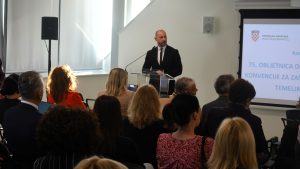
Ivan Novosel, Program Director of the Human Rights House, noted that for civil society actors, the Convention is one of the most important tools for the protection and promotion of human rights, largely due to the existence of the European Court of Human Rights (ECtHR), whose decisions are binding on member states. This enables human rights defenders to advocate for human rights standards nationally, influence judicial practice, incorporate the spirit, norms, and standards of the Convention into domestic law, and participate in proceedings before the ECtHR, including in the execution of its judgments. 
Milorad Pupovac, Chair of the Committee on Human and National Minority Rights in the Croatian Parliament, emphasized the importance of genuine institutional cooperation in safeguarding the values of the Convention, the Constitution, and human rights, as well as the role of every free individual as the foundation of society.
Mato Arlović, Deputy President of the Constitutional Court of the Republic of Croatia, noted that the Convention and its application contribute significantly to the rule of law, legal certainty, and the promotion of peace, tolerance, justice, and mutual understanding. He stressed that peace without human rights and freedoms is not genuine but a false peace, and that the protection of human rights and freedoms provides the best guarantee of a just and fair peace in which the freedom of every individual is respected.
The conference also included a roundtable on the work of the European Court of Human Rights and the impact of its case law on the national legal framework. The panel included Maša Marochini Zrinski, Judge of the Constitutional Court; Ksenija Turković, former Vice-President of the ECtHR and Professor at the Faculty of Law, University of Zagreb; Štefica Stažnik, Croatia’s representative before the ECtHR; Ioulietta Bisiouli, Director of the European Implementation Network (EIN); and Natalija Labavić, Attorney at Law. The discussion was moderated by Deputy Ombudswoman Dijana Kesonja.
During the panel, the panelists explained the influence of the Convention and ECtHR judgments on the Constitutional Court and domestic rulings, along with the practical application of rights and the Court’s key focus in this process. The discussion also covered the Court’s operational perspective, statistics, organizational structure, its dialogue with domestic courts, and the national implementation of its judgments.
It was emphasized that Europe is, unfortunately, facing a systemic crisis in the implementation of ECtHR judgments, which has, to a large extent, become a structural problem. For example, nearly half of ECtHR judgments over the past ten years have remained unimplemented or only partially implemented. Prolonged non-implementation undermines the rule of law at both the national and European levels and threatens the sustainability of the entire Convention system.
It was further noted that enforcement occurs exclusively at the national level, and without the active involvement of domestic institutions and civil society, the system cannot function. The goal of implementing judgments is not only to close cases quickly but to achieve durable and substantive solutions. Education, cooperation, and long-term planning are essential to maintaining the credibility of the Convention system.
Concluding the conference, Ombudswoman Tena Šimonović Einwalter reiterated that education, cooperation, and political will are essential not only for the effective implementation of the Convention, but also for the overall system of human rights protection, the reduction of inequality, and the strengthening of the rule of law and democratic order in Croatia and at the European level, as well as for fostering respect for fundamental rights and freedoms throughout society.