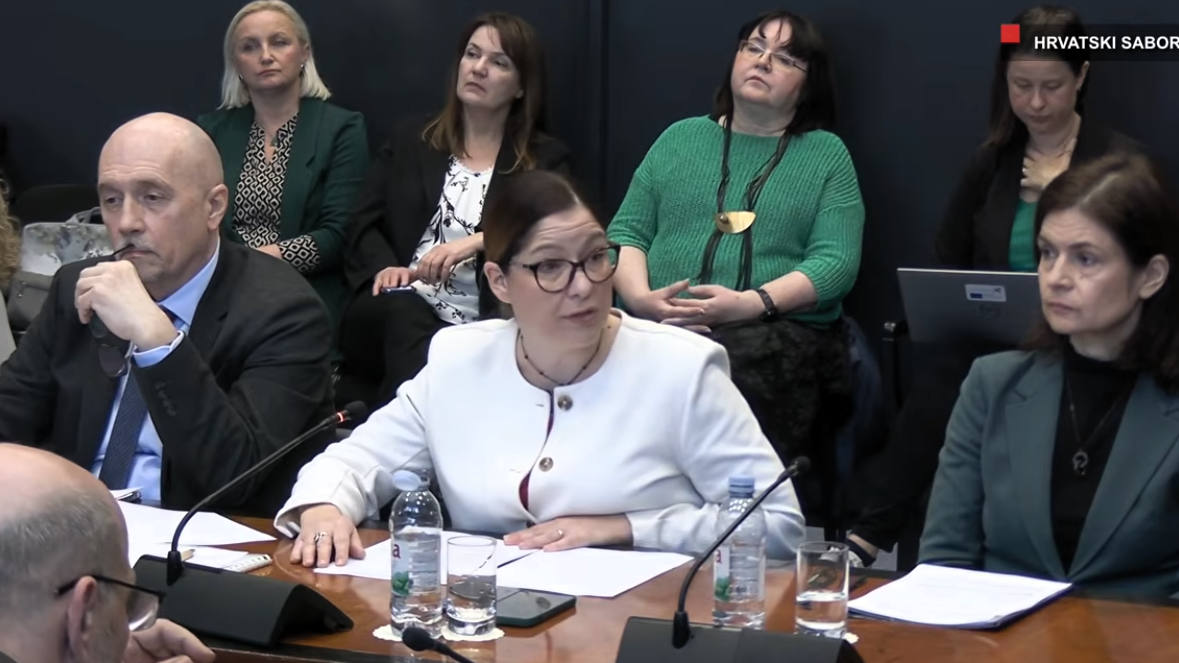
On 4 March 2026, Ombudswoman Tena Šimonović Einwalter and Deputy Ombudsman Saša Rajić presented the Report on the performance of the activities of the National Preventive Mechanism for 2024 at a thematic session of the Committee on Human and National Minority Rights of the Croatian Parliament.
In addition to the Ombudswoman and her Deputy, the discussion was attended by the Chair of the Committee Milorad Pupovac, Agent of the Republic of Croatia before the European Court of Human Rights Štefica Stažnik, State Secretary at the Ministry of Justice, Public Administration and Digital Transformation Vedrana Šimundža Nikolić, Deputy Ombudswoman for Children Tatjana Holjevac, Iris Goldner Lang and Elizabeta Ivičević Karas from the Faculty of Law of the University of Zagreb, Marija Definis from the Faculty of Medicine of the University of Split, Slađana Štrkalj Ivezić from the Psychiatric Hospital Vrapče, and Luka Kos from the Centre for Peace Studies.
At the session, the key findings and recommendations of the National Preventive Mechanism (NPM) were presented, arising from unannounced visits to places where persons deprived of liberty and persons whose freedom of movement is restricted are or may be accommodated, including police stations and detention units, prison system bodies, reception centres for foreigners, reception centres for applicants for international protection, psychiatric institutions, and homes for older and infirm persons.
The Ombudswoman pointed out that the institution has been performing the tasks of the NPM since 2012, as one of its five mandates, on the basis of international law — namely the Optional Protocol to the United Nations Convention against Torture and Other Cruel, Inhuman or Degrading Treatment or Punishment (OPCAT) — as well as national legislation, i.e. the Act on the National Preventive Mechanism for the Prevention of Torture and Other Cruel, Inhuman or Degrading Treatment or Punishment.
She emphasised that the basis of the NPM’s work is a preventive approach, implemented through unannounced and preventive visits. During these visits, the NPM does not act upon individual complaints, but carries out a systemic assessment of the treatment of persons deprived of liberty and the conditions in which they are accommodated, with the aim of preventing torture and other cruel, inhuman or degrading treatment or punishment. At the same time, within its mandate as an Ombudsman institution and a National Human Rights Institution, the Ombudswoman also acts upon complaints from persons deprived of liberty.
Following each visit, a report is drawn up containing recommendations and warnings aimed at eliminating identified shortcomings, while systemic recommendations are also included in the Ombudswoman’s annual report to the Croatian Parliament, with the aim of improving the treatment of persons deprived of liberty and the conditions in which they are accommodated.
The Ombudswoman also referred to long-standing systemic shortcomings, including inadequate accommodation conditions, lack of staff, failure to conduct effective investigations into allegations of torture, insufficient access to procedural safeguards for persons deprived of liberty and persons whose freedom of movement is restricted, insufficient awareness of their rights, as well as legislative shortcomings.
At the same time, she pointed to the positive effects of the NPM’s activities and improvements achieved in practice, emphasising that more timely consideration of the Ombudswoman’s annual reports in the Croatian Parliament would contribute to more efficient resolution of systemic issues.
Deputy Ombudsman Rajić addressed the development of the NPM mandate and the 2024 Report, including the situation identified during visits, conclusions and recommendations, noting that many of the previously identified problems persist.
In the police system, issues were identified in relation to the submission of criminal complaints for criminal offences prosecuted ex officio, as well as the identification of police officers suspected of unprofessional or unlawful conduct.
In the prison system, shortcomings relate to inadequate accommodation conditions, the continued increase in overcrowding, the quality and availability of health care, failure to conduct effective investigations in cases of violence, inter-prisoner violence, as well as deficiencies in the Act on the Execution of Prison Sentences.
With regard to applicants for international protection and irregular migrants, the need was highlighted to establish comprehensive records, ensure accommodation conditions in line with international standards, improve access to legal aid and asylum, strengthen the protection of vulnerable persons, and enable greater involvement of civil society organisations.
In the area of protection of the rights of persons with mental disorders whose freedom of movement is restricted, shortcomings were identified in medical documentation on the use of coercive measures, including their application to voluntary patients and in shared premises. The need for further alignment of accommodation conditions with standards was also emphasised, as well as the lack of institutional support following discharge.
Finally, in homes for older and infirm persons, problems were identified in relation to the insufficient number of medical staff, caregivers and professional workers, inadequate accommodation conditions — particularly in dementia wards and units for immobile users — lack of privacy, difficulties in ensuring health care, and inadequate care of immobile users in some institutions.
During 2024, the NPM carried out unannounced visits to police stations in Zadar and Biograd, the detention unit of the Zadar Police Administration, the Centre for Registration of Applicants for International Protection in Dugi Dol, reception centres for foreigners in Trilj, Tovarnik and Ježevo, the Slavonski Brod Border Police Station, Zadar Prison, Lepoglava Penitentiary, the Diagnostic Centre in Zagreb, psychiatric departments of Čakovec County Hospital and Bjelovar General Hospital, the Psychiatric Hospital Vrapče, and homes for older and infirm persons in Split, Sisak and Gospić.
The full Report on the Performance of the Activities of the National Preventive Mechanism for 2024 is available online.