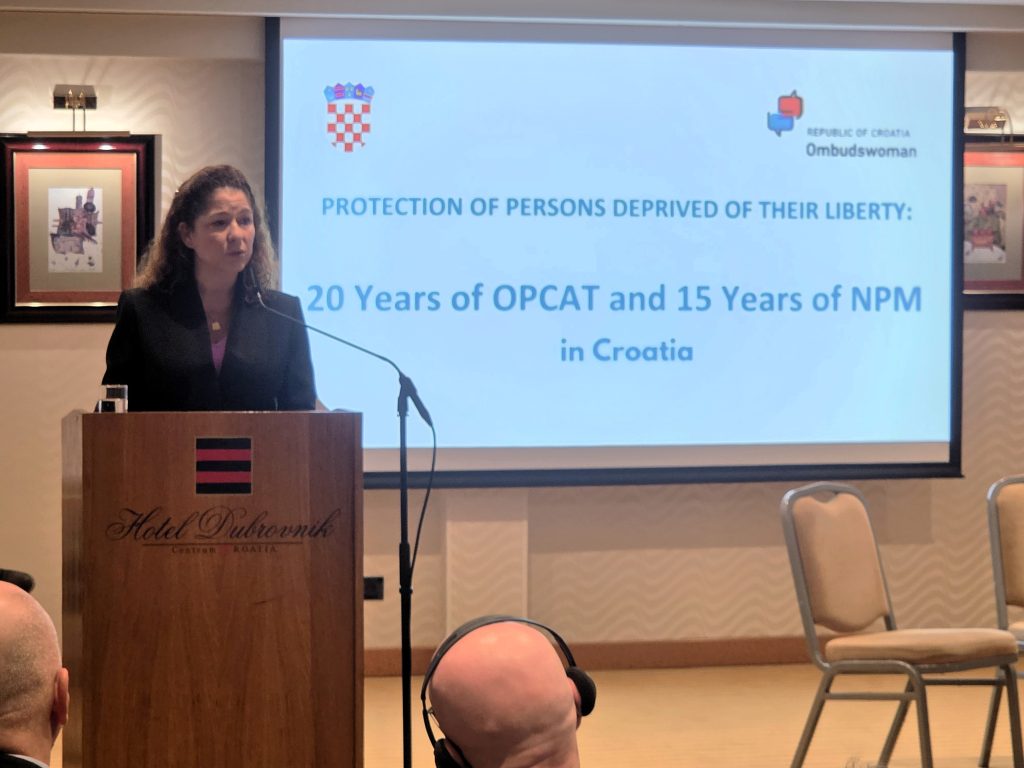
On 23 October, Ombudswoman Tena Šimonović Einwalter organised an international conference in Zagreb entitled “Protecting Persons Deprived of Liberty: 20 Years of OPCAT and 15 Years of the NPM Act”. The conference marked the 20th anniversary of the entry into force of the Optional Protocol to the Convention against Torture (OPCAT) and the 15th anniversary of the adoption of the Act on the National Preventive Mechanism for the Prevention of Torture and Other Cruel, Inhuman or Degrading Treatment or Punishment.
On the basis of these two instruments, the Ombudswoman was entrusted in 2012 with the mandate of the National Preventive Mechanism for the Prevention of Torture and Other Cruel, Inhuman or Degrading Treatment or Punishment (NPM).
Opening the conference, the Ombudswoman emphasised that OPCAT and the NPM Act, alongside the Constitution of the Republic of Croatia, form part of the legal foundations for protecting the rights of persons deprived of liberty. She recalled the state’s particular obligation to provide adequate care for people “behind closed doors”. These include people in places of detention, psychiatric institutions, care homes for older persons and reception centres. She also stressed that the prohibition of torture is absolute and allows no exceptions, regardless of an individual’s conduct. She highlighted the importance of preventive, unannounced visits, during which NPM representatives have unrestricted access to all data and information and can speak privately with persons deprived of liberty and staff. However, implementing NPM recommendations and following up on them are crucial to protection against torture. She noted that numerous problems persist across these systems, as she reports to the Croatian Parliament in her annual reports, and concluded that effective prevention requires full autonomy for the NPM to assess and decide independently which places to visit.
The Ombudswoman also emphasised that, when using technical terms and acronyms such as OPCAT, NPM and “persons deprived of liberty”, it is important to remember that we are, first and foremost, talking about people who are deprived of their liberty at this very moment. These include people who spend months in pain waiting for dental treatment because they are in prison and have no choice; people who eat and use the toilet in the same room, alongside five, six or seven cellmates, and have no choice. The wider public finds it difficult to identify with them, which also makes it harder to understand the need to protect their rights, she warned.
Milorad Pupovac, Chair of the Human and National Minority Rights Committee, emphasised that the NPM is an important mechanism established by the Croatian Parliament to strengthen its capacity to monitor how public authorities fulfil their obligations towards citizens. Reflecting on the 15 years since the adoption of the NPM Act, he noted that this was not merely the anniversary of a piece of legislation, but of a decision through which the state assumed direct legal responsibility for persons deprived of liberty. Given the prejudice they face, the NPM is a true measure of how fairly they are treated. Those who visit unannounced, speak with them confidentially and do not need to seek permission to conduct such monitoring give them a voice, he concluded.
Alan Mitchell, President of the European Committee for the Prevention of Torture and Inhuman or Degrading Treatment or Punishment (CPT), spoke about the importance of NPMs for the work of international and regional torture prevention bodies. He emphasised that independent monitoring of places where people are deprived of liberty is a fundamental safeguard against ill-treatment, and that NPMs can intervene more frequently and swiftly than any international body. He announced new CPT standards in the field of migration, drawing on empirical findings gathered through its work along all major migration routes in Europe, as well as a thematic paper on women in prison, providing a systematic overview of observations to date and a way forward towards greater integration of a gender perspective. Turning to Croatia, he stressed the importance of reviewing the conditions in which women are held, both in remand detention and while serving sentences at Požega Penitentiary. He also announced a periodic visit to Croatia in 2027, which will focus on the persistent challenges currently facing the Croatian prison system, including overcrowding, conditions in remand detention, healthcare and staffing issues.
Participants were also addressed by Nini Sandborg, an adviser at the OSCE Office for Democratic Institutions and Human Rights (ODIHR). She expressed ODIHR’s support for capacity-building and regional exchanges among national preventive mechanisms, highlighting Croatia’s successful experience and its relevance to other OSCE participating States. She emphasised the substantial difference between establishing legal standards and ensuring their application, citing Croatia as a positive example of implementation in practice. She also noted that NPMs play a crucial role in identifying problems: they can recognise the difference between the image authorities seek to present and the situation on the ground, and identify issues that are not apparent in policies or legislation. In conclusion, she stressed that international standards provide the foundation for preventing torture, while NPMs help us understand whether those standards are being respected, making them an essential part of the prevention system.
Deputy Ombudswoman Saša Rajić spoke about lessons learned and good practices in fulfilling the NPM mandate, noting that the NPM had visited more than 400 locations over the past 15 years. Some of its recommendations have remained unimplemented for many years, primarily those requiring systemic changes, amendments to the legislative framework or substantial financial resources. No instances of torture had been identified over the years, but situations that could lead to inhuman or degrading treatment had been found. Examples of the problems he highlighted included prison overcrowding, shortcomings in record-keeping and access to information concerning migrants, and the effectiveness of complaints mechanisms. He also noted that there was scope to strengthen the NPM’s impact further, both through the faster implementation of a greater number of recommendations—which requires continued improvements in dialogue and cooperation—and through more intensive visiting activities and greater visibility of the mandate.
Elina Steinerte, a member of the UN Subcommittee on Prevention of Torture and Other Cruel, Inhuman or Degrading Treatment or Punishment (SPT) and its rapporteur for Croatia, delivered an introductory presentation via video link on the application of Article 4 of OPCAT in the work of NPMs. She emphasised that torture and ill-treatment are best prevented by opening the doors of places where people are deprived of liberty, through regular and independent monitoring. Reflecting on 15 years of the Croatian NPM, she noted that it had become precisely what the architects of the system had hoped for: a first line of defence against torture, present in the country every day in a way that no international body, including the SPT, could ever be. The SPT rapporteur for Croatia also recalled the most important task of the SPT and NPMs: ensuring that no place from which a person is not free to leave falls outside the reach of prevention.
The conference also featured a panel discussion on a particularly topical issue in this field: the application of Article 4 of OPCAT in the work of NPMs. The discussion brought together representatives of NPMs from six countries: Gloria Çarkaxhiu from Albania, Kerstin Buchinger from Austria, Shqipe Mala from Kosovo, Jure Markič and Ivan Šelih from Slovenia, Maja Jović from Serbia, and Anica Tomšić, adviser to the Ombudswoman, representing Croatia’s NPM. Anica Tomšić was also recently re-elected as a member of the Subcommittee on Prevention of Torture and Other Cruel, Inhuman or Degrading Treatment or Punishment (SPT). The discussion was moderated by adviser Sara Kekuš. During the panel, NPM representatives discussed achievements and challenges in preventing torture and protecting the rights of persons deprived of liberty, focusing on findings and experiences from visits to psychiatric institutions, care homes for older persons and migration centres, as well as the implementation of recommendations that would bring about concrete changes.